


Window Heat Flux Sensors for Passive Cooling & Automated Shading Control
FluxTeq heat flux sensors are used in window, shading, and passive cooling research to measure heat gain and heat loss directly at building surfaces. By monitoring heat flux through windows, researchers can evaluate blind and shade performance, identify when windows are gaining or losing heat, validate passive cooling strategies, and develop automated shading-control systems that respond to real thermal conditions instead of relying only on light, temperature, or time-of-day schedules.
Recommended Products:

PHFS-01e
Thin heat flux sensor for direct window surface measurements.

PHFS-09e
Large-area sensor for window U-value and blind performance testing.
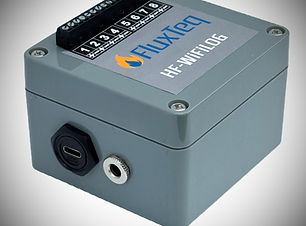
HF WifiLOG
Wireless heat flux logger for long-term building monitoring studies.
Why Heat Flux Sensors for Passive Cooling & Shading Control?
Windows are often one of the weakest parts of the building envelope. During hot weather, unshaded windows can drive solar heat gain and increase cooling loads. During cold weather, windows can become a major source of heat loss. Shading systems, blinds, natural ventilation, and passive cooling strategies can improve performance, but only when they are controlled at the right time.
Heat flux sensors directly measure whether heat is entering or leaving a space through a window or building surface. This makes heat flux especially valuable for automated shading control, passive cooling research, and window heat-transfer studies because it provides a direct thermal signal.
For example, a heat flux value near 0 W/m² can indicate the transition between window heat gain and heat loss. That gives researchers a physically meaningful control point for deciding when to deploy or retract shades. This is different from light sensors or temperature sensors, which often require climate-specific, season-specific, or building-specific setpoints.
FluxTeq sensors can support:
-
window heat gain and heat loss measurement
-
automated shading control research
-
passive cooling and natural ventilation studies
-
blind and shade thermal performance testing
-
in-situ window U-value measurement
-
solar heat gain reduction studies
-
building energy simulation validation
-
wireless long-term building monitoring
The studies summarized here were conducted by independent researchers. FluxTeq did not necessarily design, perform, or validate the experiments. These publications are provided as examples of how FluxTeq sensors and DAQ systems have been used in battery thermal research.
Direct heat flux sensing for window shading control in passive cooling systems
Energy and Buildings, 2022

Link: https://www.sciencedirect.com/science/article/abs/pii/S0378778822001219
Application: Automated window shading control using direct heat flux sensing
Relevant sensor: PHFS-01e
Summary:
The researchers investigated whether direct heat flux measurement at window surfaces could provide a better control signal for operable shades than illumination, solar radiation, air temperature, or time-of-day schedules.
The study used FluxTeq PHFS-01e thermopile heat flux sensors mounted to the interior surfaces of double-glazed east-, south-, and west-facing windows at the University of Oregon. The heat flux signals were recorded using Arduino-based electronics and then used to characterize signal noise, develop filtering methods, and simulate shading-control performance in EnergyPlus.
The key idea is powerful: 0 W/m² can act as a universal control threshold. When window heat flux is positive and cooling is desired, shades should be deployed; when heat flux reverses, shades can be retracted to allow nighttime heat loss. The paper found that filtered heat-flux-based shading control reduced window solar heat gain by 54–78% across six contrasting climates, performing comparably to or better than established illumination- and solar-radiation-based controls.
Why this application matters:
This paper positions heat flux sensing as a direct control input for smart buildings. Instead of guessing whether a shade should be open or closed based on sunlight or time of day, the sensor measures the actual heat transfer through the window. That is a strong story for passive cooling, automated shading, residential energy efficiency, and climate-responsive building controls.
Link: https://www.sciencedirect.com/science/article/pii/S2352710225001706
Application: In-situ window U-value testing and blind thermal performance
Relevant FluxTeq product: PHFS-09e
Summary:
This study evaluated the thermal performance of internal blind systems installed in an office at the University of Alberta in Edmonton, Canada. The researchers tested three shade positions: fully open, fully closed, and half open. The goal was to measure how blinds influence heat loss through double-pane windows in a cold climate and then use CFD modeling to better understand the window-shade thermal behavior.
The researchers used FluxTeq PHFS-09e large surface area heat flux sensors to measure heat flux through the windows. The sensors included integrated T-type thermocouples for glass temperature measurement, while additional thermocouples measured air and surface temperatures. Data were collected at 15-second intervals, then averaged for U-value calculations according to ISO 9869-style methods.
The paper found that fully closed shades reduced energy loss by 11.25%, while half-open shades reduced energy loss by 5.34%. The measured heat flux showed that deploying the shade significantly reduced heat leaving the window on comparable cold nights. The study also validated CFD results against in-situ measurements and developed performance U-values for shaded and unshaded conditions.
In-situ testing and numerical study of thermal performance of blind systems in a cold climate zone
Journal of Building Engineering, 2025

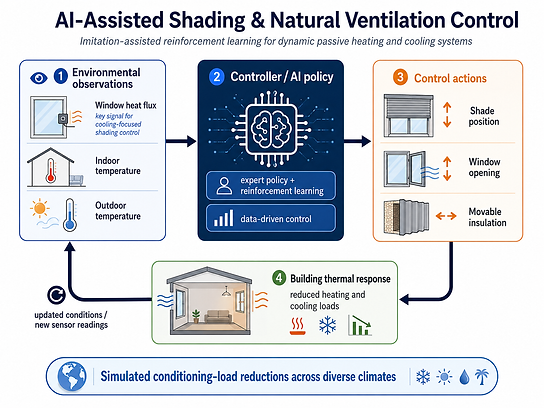
Performance, robustness, and portability of imitation-assisted reinforcement learning policies for shading and natural ventilation control
Applied Energy, 2023
Link: https://www.sciencedirect.com/science/article/abs/pii/S0306261923007286
Application: AI-assisted control of shading, natural ventilation, and movable insulation
Relevant sensor category: PHFS-01e
Summary:
This paper developed a data-driven control strategy for dynamic passive heating and cooling systems using imitation-assisted reinforcement learning. The control system operated shading, window apertures, and movable insulation to reduce space heating and cooling loads in residential building simulations.
The control framework uses window surface heat flux as one of the environmental observations. The authors specifically cite prior work showing that window heat flux is a promising metric for shading control because it indicates net window heat gain or heat loss independent of space, orientation, or climate. They also note that low-cost heat flux sensors and filtering methods make heat flux sensing an affordable control option.
In the expert policy, window heat flux was chosen as the key parameter for cooling-focused shading control. The paper describes shading being extended when the window gained heat and retracted when the window definitively lost heat. The resulting reinforcement-learning policies reduced simulated late-spring space-conditioning loads by at least 40% in 24 climatically diverse cities, and later achieved reductions of at least 50% in humid subtropical climates and at least 90% in three other climate groups when deployed in related but unfamiliar climates.
Why this application matters:
Heat flux sensors can become part of smart, AI-assisted building controls. Instead of only measuring building performance after the fact, window heat flux can be used as a real-time input for automated shading, natural ventilation, and passive heating/cooling strategies.
Link: https://www.sciencedirect.com/science/article/abs/pii/S0306261922006729
Application: Passive cooling, heat-wave resilience, shading, and natural ventilation
Relevant sensor: PHFS-01e
Summary:
This paper studied how passive cooling strategies could have improved indoor survivability during the severe June 2021 Pacific Northwest heat wave. Using EnergyPlus simulations, the authors evaluated shading, natural ventilation, fan-assisted ventilation, and combinations of these strategies in multifamily apartments in Portland, Seattle, Spokane, Eugene, and Vancouver.
The study found that, in Portland, integrated shading and natural ventilation eliminated all hours above the “danger” heat-index threshold during the three-day event and lowered peak indoor air temperatures by approximately 14 °C / 25 °F. It also found that passive cooling reduced active cooling loads by up to 80%.
The study also highlights the importance of control strategy. Natural ventilation was most effective when used during cool nighttime hours, while combinations of shading and natural ventilation performed best when shading was active during direct sun and ventilation was active when outdoor air was cooler than indoor air. In the simulations, combined shading and natural ventilation eliminated “extreme danger” and “danger” hours even during the heat wave and provided 140–160 hours of thermal relief during the surrounding ten-day period.
Why this application matters:
This paper provides the broadest public-health and climate-resilience motivation. The findings show why real-time monitoring and control of window heat gain, shading, and passive cooling can be important as extreme heat events become more common.